
Two-Shot Injection Molding
Manterra provides two-shot injection molding in Delta, BC, Canada. Two materials or two colours are molded into one part in a single cycle, so a rigid housing comes off the press with its soft grip, seal or second-colour graphics already in place, with no glue and no assembly step.
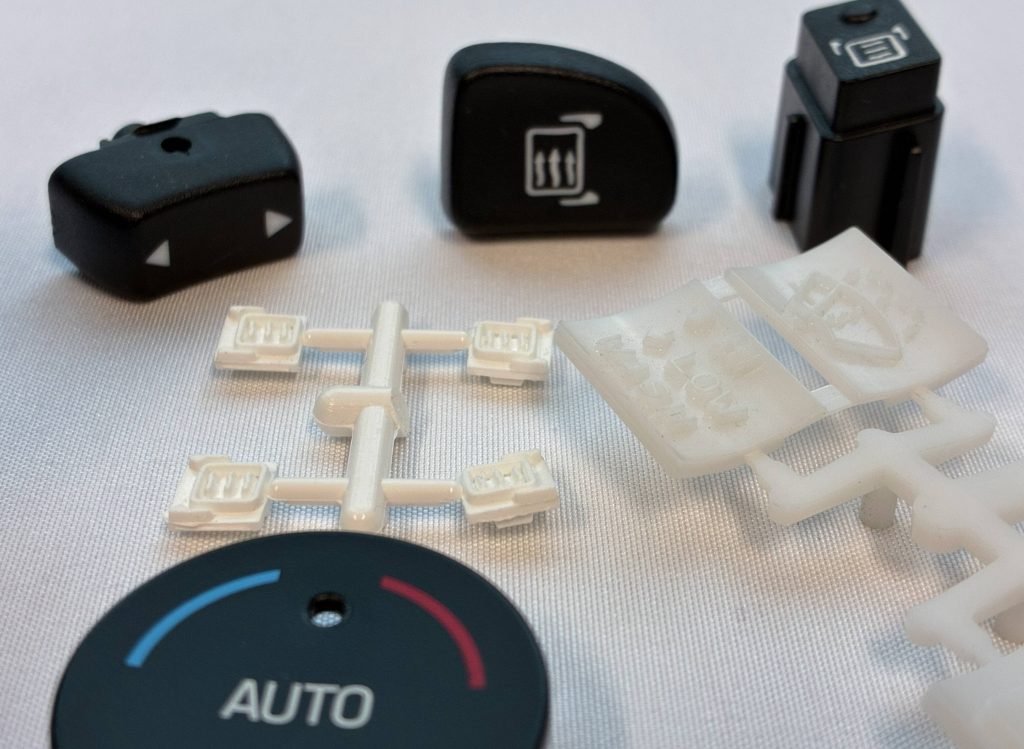
How Two-Shot Injection Molding Works
Two-shot molding, also called 2K or multi-shot molding, runs on a press with two injection units and a specially built mold. The first unit injects the substrate. The part then moves to the second-shot position within the same mold, either by the mold rotating, by a section of the mold retracting, or by a robot moving it to a second cavity, and the second unit injects the second material onto it while it is still warm. Both shots happen in every cycle, so every cycle produces a finished two-material part.
Why Choose Two-Shot Molding?
- No assembly or adhesive: the soft grip, seal or second colour is part of the molded piece, so there is nothing to glue, press on or line up.
- Graphics that can’t wear off: symbols, icons and logos molded in a second colour go all the way through, so they won’t rub off with use the way printing does.
- Precise placement: the tool locates the second material in exactly the same place on every part.
- A strong bond: the second shot meets a substrate that is still warm, which helps compatible materials fuse.
- Lower piece price at volume: one cycle replaces a molding step and an assembly step.
Two-Shot or Overmolding?
Both put two materials into one part. Two-shot molding needs a more complex tool and a two-shot press, so it pays off at higher volumes and where the two materials must line up precisely. Overmolding places an already-molded part into a second tool, which costs less to tool and suits lower volumes. See Overmolded Elastomers for more on that process.
As a rule of thumb, two-shot molding makes sense when annual volumes are high enough to pay for the more complex tool, when the second material has to sit precisely in place, or when graphics must last the life of the product. For prototypes and short runs, overmolding or a separate part usually costs less. Send us your volumes and drawings, and we’ll recommend the most economical route.
Material Pairs That Bond
Two-shot parts combine either a rigid and a soft material or two rigid materials in different colours. Common soft-on-rigid pairs are TPE on polypropylene, TPU on polycarbonate or PC/ABS, and modified TPE grades on ABS or nylon. Rigid pairs include two colours of the same resin, or clear polycarbonate or acrylic with an opaque second shot for light pipes and backlit symbols. Where two materials won’t bond chemically, the tool adds holes, undercuts or wrap-around edges that lock them together.
Designing for Two-Shot Injection Molding
Two-shot parts are designed as a pair. The substrate must be stiff enough to hold its shape when the second shot hits it, and it needs crisp shut-off edges where the second material stops, so the soft layer doesn’t flash onto visible surfaces. Keep the second shot’s walls reasonably even, gate it away from cosmetic faces, and add interlocks wherever the bond needs help. We review these with you before the tool is built, because two-shot tools are expensive to change.
Two-Shot Parts We Make
- Automotive components with soft-touch or two-colour surfaces
- Two-colour logos and branding molded into the part
- Rigid parts with integrated soft-touch grips and seals
- Buttons and keypads with molded-in symbols that won’t wear off