
Automated Injection Molding (Operator Automation)
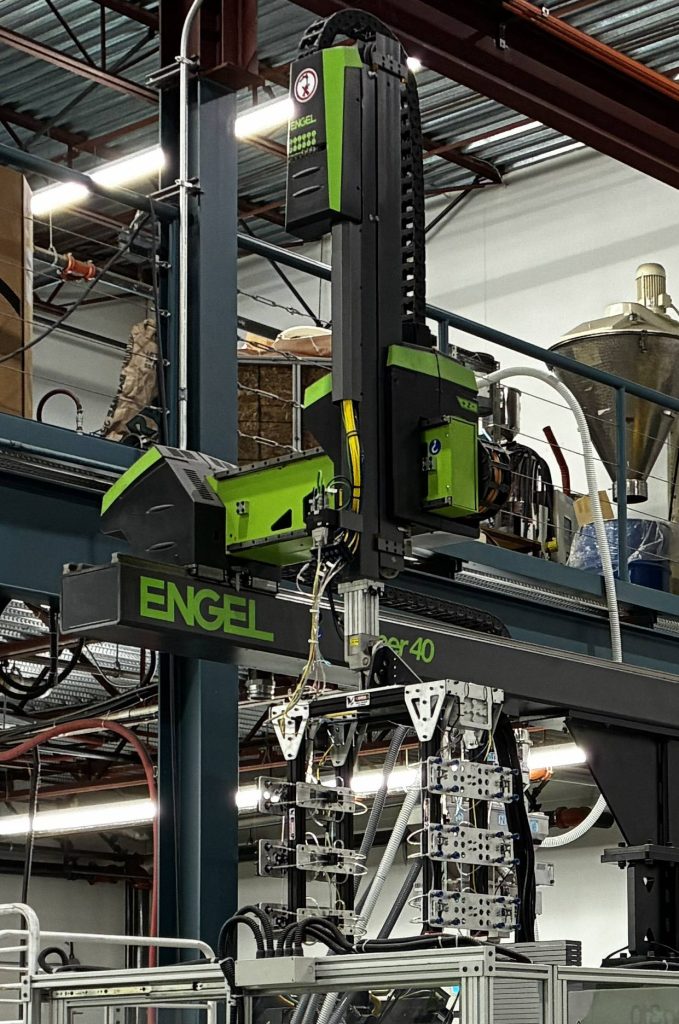
Manterra uses automated injection molding to keep part costs competitive with offshore suppliers and to handle cosmetic and delicate parts without damage. Robots remove parts from the mold and place them on a conveyor or tray the same way every cycle.
Why We Automate Injection Molding
Competing with offshore molders takes more than modern presses. Robotic part removal makes cycle times consistent, cuts handling labour and lets our operators spend their time on setup, inspection and assembly instead of unloading parts.
- Continuous production: automated cells can run around the clock, which shortens lead times on high-volume orders.
- Lower part cost: automating part removal and staging takes labour out of every part, and we pass those savings on in our pricing.
- Consistent cycles: when a press waits for an operator, some parts cool in the mold longer than others. A robot removes every part at the same point in the cycle, which keeps shrinkage and dimensions consistent.
Robotic Part Removal and Handling
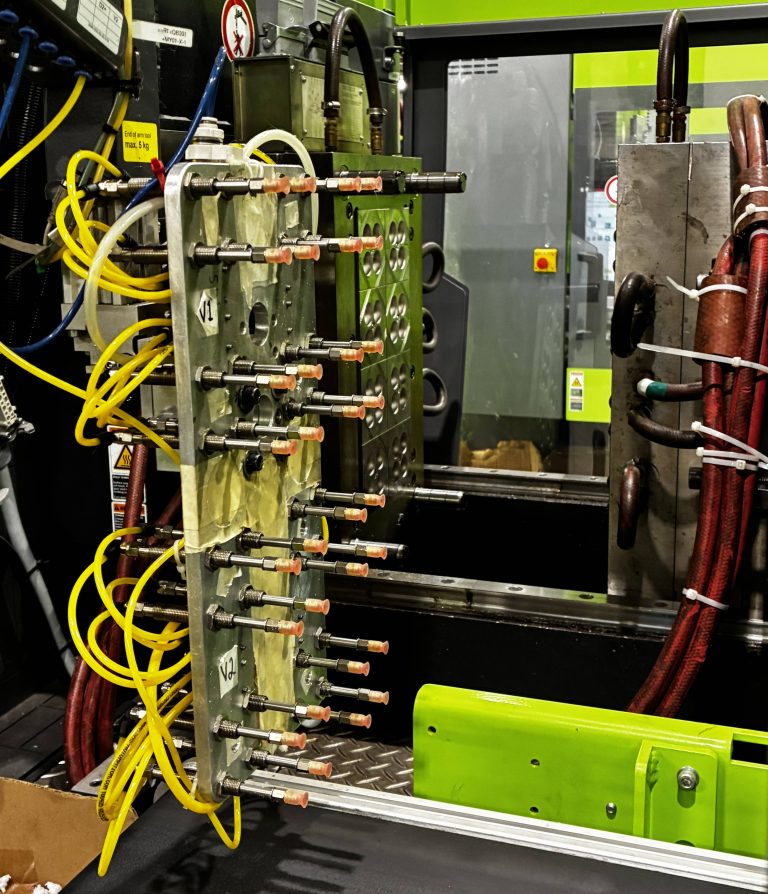
Not every part can be handled the same way. Cosmetic, clear and thin-walled parts can scuff, scratch or pick up fingerprints when they are pulled by hand or dropped into a bin.
- Gentle extraction: End-of-arm tooling is made for each part and grips it by vacuum cups or fingers on non-cosmetic surfaces. The robot lifts the part out of the mold and sets it down on a conveyor or tray instead of dropping it.
- Repeatable handling: the robot is programmed to remove every part with the same motion, speed and timing, so handling no longer varies between operators and shifts.
- Ready for the next step: parts are set down in a fixed orientation, ready for inspection, assembly or packing, instead of tumbling into a box.
Connecting the Press Floor to Our ERP
Automation continues past the press. We link production and inventory data to our CyFrame ERP and use custom software tools to cut manual data entry. Shipping and logistics paperwork comes from that data, so administration keeps pace with production.
- Bridging the Physical and Digital: We utilize custom cross-platform automation tools to eliminate manual data entry and streamline backend operations.
- ERP & Logistics Automation: By directly linking our production and inventory data with enterprise systems like our CyFrame ERP, we automate complex logistics and shipping tasks in real-time. This ensures that the speed of our administrative workflows matches the speed of our robotic manufacturing.
Automation and Quality
Automation removes a source of variation, but it doesn’t replace inspection. Our quality system, certified to ISO 9001, ISO 13485 and IATF 16949, still sets first-article inspection, in-process checks and traceability for every job. The robot makes the process more repeatable; our inspectors confirm the parts are right.
Parts That Benefit Most from Automation
- Clear lenses and light pipes, where a fingerprint or scuff is a reject
- Parts going on to painting or chrome plating, where surface contamination shows after finishing
- High-volume parts on long production runs, where labour is a large share of part cost
- Large parts that are heavy or awkward to lift from the bigger presses
Where Operators Still Matter
Automation handles the repetitive work; people handle the judgment. Our technicians set up molds and robots, tune the process, inspect parts and run assembly. For short runs and prototypes, where programming a robot costs more than it saves, trained operators remove parts by hand and follow the same handling instructions.
Planning Automation for Your Part
When we quote a new part, we look at whether automated injection molding suits it: part size, cosmetic requirements, annual volume and how the part needs to be packed. If a robot can improve quality or reduce cost, we plan the end-of-arm tooling alongside the mold, so automation is ready from the first production run.